
Proning: How to “prone” yourself at home
You might have come across the term “proning” when reading the newspapers during the Covid-19 pandemic. This term describes the procedure followed when a critically ill, ventilated patient, gets turned on his or her stomach in ICU. The reasons why doctors order a patient to be turned and nursed on his or her stomach are multiple and complicated. Simply put, the prone position may aid oxygenation and lung expansion and make the effort of breathing less. What is new is that several articles now recommend that patients who are not yet ventilated, also be proned in an attempt to prevent them from ending up on ventilators.
When you are lying on your stomach, your diaphragm helps to expand the bottom parts of your lung, often neglected when we sit or breathe fast.
If you find yourself diagnosed with COVID-19 and are sent home to self-isolate with symptomatic medicines, proning is one of the breathing treatments you can do yourself. Simply put, you lie down on your bed, on your stomach. There are a few things to consider before you do this.
NOTE: Contra-indications for proning:
- Recent abdominal surgery or open abdominal wounds
- Within 2 hrs of having a meal
- Having spinal instabilities
- Conditions associated with increased intracranial pressure
- Arrhythmias (irregular heartbeats)
- General discomfort when lying on your stomach or lack of tolerance of this position
If none of the above apply to you, and you are not used to lying on your stomach when you sleep, consult your health care practitioner to advise the safety of this position. Also consult your healthcare professional if you are living by yourself or have movement limitations before attempting this treatment.
Below is a step-by-step guide on the details of proning:
- Step 1: Find and place a firm pillow on your bed, as to position it under your hips.

- Step 2: Lie down on your stomach, with the pillow under your hips.

- Step 3: Ensure your stomach is hanging free and that the pillow is not obstructing the free movement of your stomach during breathing.
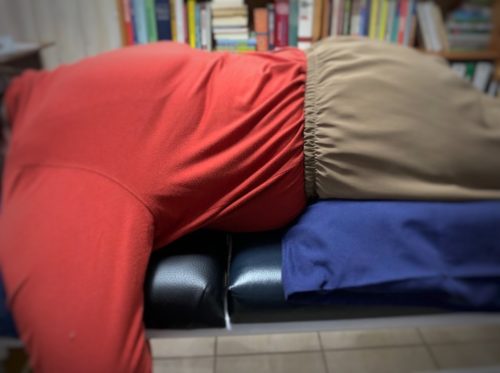
- Step 4: Ensure that your neck is in a comfortable position. You may use a pillow to support your head and neck, or a rolled towel or you may cup your hands to place your forehead into them.
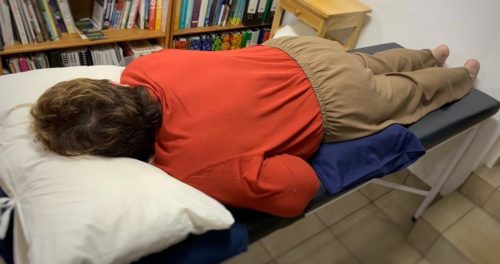
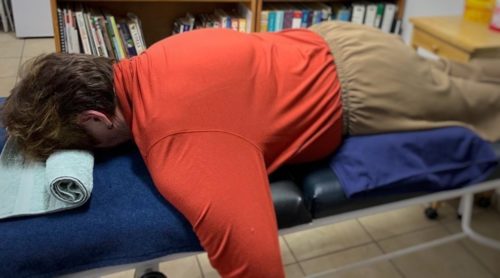
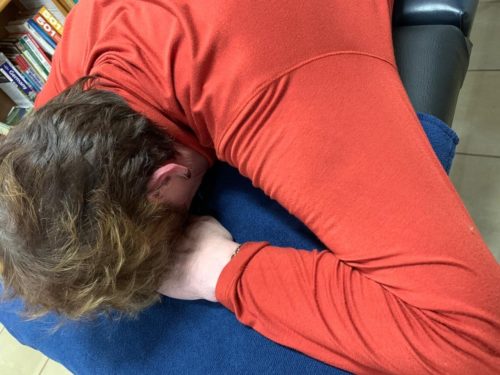
- Step 5: Maintain this position for 20 minutes.
NOTE: Should your breathing alter and become more difficult, please cease staying in the position. This position should help ease your breathing. If you do not find this position helpful, please cease using this position immediately.

Lizanne qualified as a physiotherapist in 2000 at the University of the Free State, South Africa.
She has a special interest in cardiorespiratory conditions and rheumatology. She is currently working as part of a multidisciplinary team treating patients with chronic pain and rheumatological conditions in Pretoria, South Africa.